The global rubber market recorded mixed ups and downs as Asian exchanges reacted to oil price fluctuations and expectations of stimulus policies from China. Domestically, rubber latex purchase prices were maintained stable by businesses, ranging from VND346/TSC to VND422/TSC and from VND12,300/kg to VND18,000/kg depending on the type and quality of latex.
Domestic rubber prices
At Mang Yang Rubber Company, the purchase price of grade 1 latex is maintained at VND399/TSC/kg, grade 2 at VND388/TSC/kg. Grade 1 mixed latex is purchased at VND395/DRC/kg, grade 2 at VND346/DRC/kg.
Phu Rieng Rubber Company maintains the price of grade 1 latex at VND420/TSC/kg, mixed latex at VND390/DRC/kg.
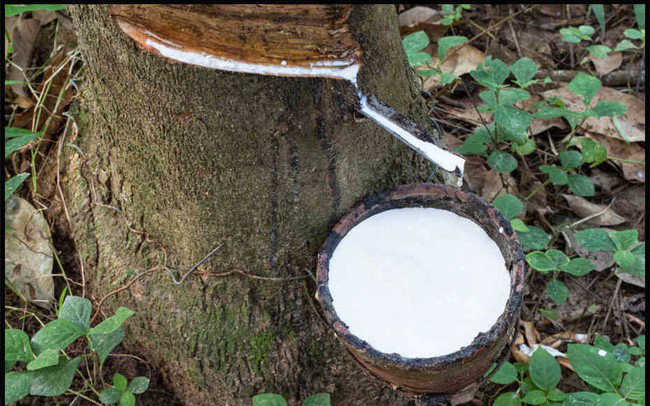
At Ba Ria Rubber Company, the price of water latex ranges from 390 - 400 VND/TSC/kg depending on the TSC level, while the price of mixed latex with DRC ≥ 50% is the highest at 18,000 VND/kg.
Binh Long Rubber Company maintains the purchase price of water latex at the factory at 422 VND/TSC/kg, at the production team at 412 VND/TSC/kg; the price of mixed latex with DRC 60% is at 14,000 VND/kg.
In general, large enterprises apply a strict quality control mechanism, with price deductions based on pH or filler content to stabilize the market and ensure that raw materials meet standards.
World Rubber Prices
On the Shanghai Futures Exchange (SHFE), September rubber futures rose 0.24% to 14,795 yuan/ton, while in Thailand, August futures rose 0.4% to 71.36 baht/kg.
In contrast, the Japanese market decreased slightly when the price of RSS3 rubber for September delivery on the Tocom exchange decreased by 1.23% to 320.2 yen/kg; the October to December terms also decreased by 0.03 - 0.19%.
In Singapore, the price of TSR20 rubber for September delivery reached 171 cents/kg, up 0.41%, while the futures increased by 0.52%.
In Malaysia, the price of SMR20 rubber decreased by 7.5 sen to 729 sen/kg and the price of block latex decreased by 3.5 sen to 568.5 sen/kg.
This mixed trend was due to a double impact, on the one hand, the weakening oil price caused downward pressure, on the other hand, the expectation that China would launch more economic support packages and concerns about unfavorable weather in Thailand limited the decline. In addition, geopolitical tensions and the US economic outlook also made market sentiment more cautious.
Analysts say that in the short term, world rubber prices may continue to fluctuate around current levels due to simultaneous influences from oil price fluctuations, China’s economic policies, and supply-demand in major Asian producing countries. Domestically, maintaining stable prices shows that rubber enterprises are proactively regulating supply, ensuring the interests of growers, and maintaining sustainable production.
https://thuongtruong.com.vn/news/gia-cao-su-ngay-208-bien-dong-trai-chieu-tren-thi-truong-the-gioi-trong-nuoc-giu-on-dinh-147965.html



